Beaches
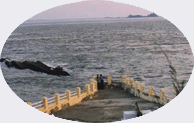
Ngapali, Chaung Tha, Kan Thaya and Ngwe Saung are stretches of unspoilt beaches ideal for lovers of sun, sand and sea.
Myanmar's beaches have been untouched by commercialism and unpolluted by the litter of large crowds and so continue to maintain their pristine beauty and cleanliness. Long stretches of white sand touched by the blue sea and drenched by the sun offer an ideal place for lovers of the sea, sand and the sun. Among the most popular beaches are: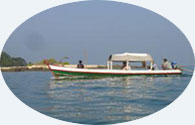
Ngapali Beach
Ngapali Beach is the most beautiful beach among the beaches in Myanmar. Its beautiful sandy beach stretches on the Bay of Bengal and it lies in Rakhine State of Myanmar.
Apart from the normal beach activities, excursions like visiting the small fishing villages and local markets; exploring the countryside by bicycle and a boat trips to the magnificent offshore islands can be experienced in Ngapali. There is also the 18-hole Golf Course just 15 minutes drive from the hotel to fulfill the taste of beach golfers.
Once there was a home sick Italian who said the beach looked like the Naple beach in Italy. And it is assumed to have descended from the word "Naple". There is no meaning in Myanmar or Rakhine about Ngapali.
Ngapali is accessible by flight which takes about 45 minutes from Yangon, by car about 14 hours drive along the Rakhine Yoma mountain range. Yangon Airways, Air Mandalay and Air Bagan fly from Yangon to Ngapali daily and there are also direct flights from Heho and Nyaung Oo to Ngapali. The best time to visit is during October to May.
Ngwe Saung Beach
Ngwe Saung is also on the western coast of Myanmar on the Bay of Bengal, nearly directly west of Yangon and a bit south of Ngapali. It has become popular with tourists in just the last two or three years and the quality of the beach, sand and water is comparable to Ngapali Beach. There are only a few hotels (most of them are deluxe or superior category) however a few more are being built. Until recently, the beach could be reached only by car (about 5-6 hours drive) from Yangon, or by a tourist ferry that would make an overnight trip (but sometimes the boat would not run if they did not have enough bookings). Now, the new domestic air carrier Air Bagan, has started flying to Pathein on a regular basis. It is about a 25 minute flight to the city of Pathein and from there a one hour transfer by car to the beach. Like Ngapali Beach, the beauty of the beach is unspoiled and visitors can enjoy a peaceful and relaxing holiday.
Saturday, October 14, 2006
To release from your stress, Enjoy here!!!

Best Architecture in the world - Bagan - Myanmar

History Getting Around Interesting places
History
Bagan dates back almost to the beginning of the Christian Era. It lies on the bend of the Ayeyarwaddy River. Bagan can be marked to have started with King Anawrahta. He ascended the throne of Bagan in 1044. At that time, the kingdom was under the Mahayana religion. After Shin Arahan's arrival to Bagan, it converted to Theravada Buddhism. It was said to be that each and every household was able to donate an enshrined Pagoda, because of their faith in Buddhism believe and also because of their wealth.
The great Shwezigon was one of King Anawrahta's donation during his time.
Top
Getting Around
Horse carts are popular ways travelling around Bagan. Visitors can also hire bicycles at some hotels and guest houses to roam around. The charges are taken per hour service. Ferry boats can also be hired to flow in the Ayeyarwaddy. The ferry stand is near the Bu Pagoda. The views from the Ayeyarwaddy is also an interesting way to explore Bagan.
Bus and Express
There are Daily Expresses from Yangon and other major cities.
Car
One can hire a car from a car rental agency or from a travel agent. Different types of cars, coach seaters are available.
Train
Air
There are daily flights from Air Bagan, Yangon Airways, Air Mandalay and Myanmar Airways to Nyaung U Airport, Bagan. The flight schedules may change from time to time depending on the weather. But this is the fastest way to explore Bagan.
General Information
Today, Bagan has many hotels and guest houses to stay in.One should also buy a map of Bagan, so that people can travel alone depending on their interests. Many souvenirs and antiques can be bought near the Bagan Pagodas. But it is also a bit difficult to differentiate between the genuine and fake. There are entrance fees to the Bagan Zone, Bagan Museum and some pagodas too. More detail of entrace fees click here.
Top
Places to Visit in Bagan

Gubyaukgyi
Gubyaukgyi is close to Wetkyi-in village. This 13th-century 'cave temple' has an Indian-style spire like the Mahabodhi Paya in Bagan. Gu meaning "cave" in Myanmar.
It is interesting for the fine frescoes of scenes from the jatakas.
To distinguish it from the temple of the same name in Myinkaba, this monument is sometimes called 'Wetkyi-in Gubyaukgyi'.
Top
 Shwezigon Pagoda
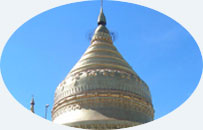
Shwezigon is situated between the village of Wetkyi-in and Nyaung U. It was first built by King Anaweahta then completed by Kyansittha (1084-1113). Shwezigon enshrines one of the four replicas of the Buddha tooth from Sri Lanka. The other three are enshrined in Lawkananda, another one in Tankyi Taung Pagoda and the last one in Tuyin Taung Pagoda. There is a local saying that if one person visits and pay homage to all these four pagodas in one day, the person will gain prosperity and fulfilment.
There is a 10-cm circular indention in a stone slab near the eastern side of the pagoda, which was filled with water to allow royal families to look at the reflection of the hti (the tip of the Pagoda) without tipping their heads backward.
The graceful bell shape of this pagoda became a prototype for virtually all later pagodas all over Myanmar. The gilded pagoda sits on three rising terraces.
Enamelled plaques in panels around the base of the zedi illustrate scenes from the previous lives of the Buddha. At the cardinal points, facing the terrace stairways, are four shrines, each of which houses a four-metre-high bronze standing Buddha.
Tharabar Gateway
Tharabar is derived from the Pali term “Sarabhanga” meaning “Shield Against Arrows.”
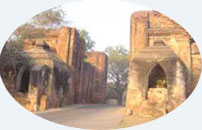
This gateway is what remains of the royal city of Bagan founded by King Pyinbya in A.D 9th century, of the walls of the fourth City of Bagan that the king built in A.D 849.
It was known that the fourth City of Bagan had twelve gates around the city wall. The western and the north western parts have been totally washed away by the river. Only this eastern gateway is left. Most of the structure has been ruined by weather and the earthquake of 1975. Stucco carvings of ogre clutching garlands and chaplets of pearls can be discerned. There is a masonry shrine of quite massive proportions on each side of the gateway. One commemorating the Lord of the Gate Mountain also known as "Pabe Maung Tint Te" and the other his Sister "Shwe Myathnar". They are regarded to be guarding the city.
Top

Lawkananda Pagoda
Lawkananda Pagoda was built in 1059 by Anawrahta, who is also credited with the Petleik payas. It is still used as an everyday place of worship and is thought to house an important Buddha-tooth replica.The riverside and sunset views from Lawkananda are very good.
Lawkananda Pagoda has one of the Buddha's tooth relic enshrined in it, which was brought from Sri Lanka. It is situated on the bank of the Ayeyarwaddy River.

Bu Pagoda
Bu Paya is said to be known to be constructed during the 9th Century, about 850 AD. It is situated on the bank of the Ayeyarwaddy River. It is a cylindrical shaped Pyu-style pagoda and is said to be the oldest among many temples in Bagan. Bupaya was completely destroyed when it tumbled into the river in the 1975 earthquake, but has since been totally rebuilt. There are many steps leading into the river.
Top
Bagan Museum
The new Bagan Museum glorifies the golden age of Burman culture, those 250 years during which thousands of temples were built in and around the Myanmar capital of Bagan. The builders of Bagan apparently reserved brick for religious monuments for nothing remains of the other buildings, that must have been wooden, in this great capital.The Bagan Archaeological Museum is situated within Old Bagan city near the Gawdawpalin Temple was established in 1998. On entering the museum, one will first view bronze statue of four famous Kings of Bagan period namely Anawyahta, Kyansitthar, Alaungsethu and Kjaswa and large three dimension of mural painting on the wall depicted Bagan Archaeological Site.
Many masterpieces of excavated objects and concrete evidences are stored in this building. It has a collection of more than 2500 items including Buddha statues, stucco pieces, terra-cotta cups and pots. Museum also houses stone sculptures, wood carvings, metal works, lacquer works, and many more.
Different postures of Buddha images (Mudra) made of gold, silver, bronze, stone and wood are also displayed. Among them, one can see the significant bronze lotus Bud, a masterpiece of bronze sculpture of Bagan period.
Myazedi lithographed inscription of four languages in Pali, Pyu, Mon, and Myanmar is an astonishing
literature and cultural heritage.
Top

Inland the country rises in gently undulating slopes. The most noticeable feature is Popa Hill, or the Mt. Popa, an extinct volcano, to the south-east. The highest peak is 1518 metres (4,981 feet) above sea-level. The volcano is known to be extinct since 250,000 years. The volcanic ash makes the surrounding plains fertile and the heights capture the moisture of passing clouds, causing the rain and to make this place an oasis in the middle of the hot plains of Bagan. Mt Popa has about 200 water streams around it. Hundreds of Monkeys dwell in this region.
Mt. Popa is considered to be the adobe of the Myanmar Nats or Powerful Spirits. Thus most of the Nats are worshipped here. There is a yearly festival worshipping the Nats at Mt Popa. Usually the festival takes place during May-June.
Top
Beauty Queen of Myanmar - Pyin Oo Lwin

Pyin Oo Lwin
Pyin Oo Lwin was formerly known as May Myo. It is a resort town in Mandalay Division in Myanmar, located some 67 kilometers east of Mandalay, and at an altitude of 1070 meters (3510 feet). It was initially a Shan village situated between Naungcho and Mandalay on the Lashio-Mandalay road.
During the British colonial occupation, the British, in 1896, developed it as a hill station because of its cool alpine climate, especially during the hot season. The colonial government of Myanmar would move to May Myo during the hot season to escape from the high heat and humidity of Yangon. The name May Myo means May Town in Burmese, and comes from the town's first administrator, Colonel May. As a legacy of the colonial period, the town has approximately 10,000 Indian and 5,000 Nepali inhabitants, who served in the British Indian Army and settled in May Myo after the British left, and granting independence to Burma. May Myo was also an important educational centre during colonial times, with the Government English High Schools, such as St. Mary's, St. Michael's, St. Albert's, and Colgate, all based in the town. It is also home to the Myanmar Defence Services Academy (DSA).
Major Attractions
 Kandawgyi National Garden- It was known as May Myo Botanical Garden. It consists of a variety of plants, trees, flowers and animals. It is a 49 acres natural forest. It opens daily from 7am to 5.30pm.
 Pwe Kauk Water Fall - It is 8km from the town, off the Lashio road. It is a pleasant picnic spot.
 Peik Chin Myaung - This is a large Buddhist shrine cave about 27km from the town. About 600 meter path leads through the cave. Inside the cave are several Buddha images donated by locals.
Read More......
Friday, October 13, 2006
One of the most powerful kingdom in history, Mrauk Oo - Myanmar
Mrauk U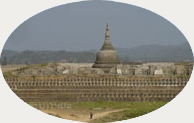 Ancient city of MraukOo, known as Myohaung meaning the ancient city is situated 50 miles (80 km) inland from the mouth of Kaladan River, on a rocky plateau between Kaladan and Le-mro rivers. The remnants of a 30 km long fortification can still be seen. Mrauk U was once, one of the most powerful kingdom in history. The Rakhine King "Min Saw Mon" founded Mrauk U in 1433. Mrauk U was a leading trade city during its time, and abundant networks of canals allowed small and large vessels to go by. It traded with Middle East, Asia, Holland, Protugal and Spain. The Mrauk U dynasty lasted for about 352 years.
 Rakhine people and Rakhine cultures are rich in contents and high in spirit making up the major pillar of Myanmar union. Since A.D. 1430, ancient city Mrauk-Oo had been capital of a coastal nation, strategic in merchant routes between India and Eastern ports of Java-Sumatera and beyond to China, until late 18th Century. Surviving monuments, stupas and pagodas at Mrauk-Oo Archeological Zone reflects the past glories of 354 years under the lineage of 49 kings. Preceding Mrauk-Oo era are Din-ra-wady, Wei-tha-li and Le-mro eras, from where cultural values are carried along.
Mrauk-Oo is one of the splendid archeological sites South East Asia has retained. Monumental edifices could not fail to bring forth the images of past, rise and fall of a glorious City.
Major Attractions 
Royal Palace- The ruins of the Royal Palace which was built in 1430 can still be seen. The palace had massive wooden columns which are burnt down.
Shittaung Pagoda - Meaning 80,000 pagoda in Myanmar. Built in 1535 by King Minbin. It has a maze like floor plan inside.
Koetaung Pagoda - Built an ordination hall with a single pagoda rising at the centre. Underneath is a huge cave where 90,000 Buddha images are consecrated in the maze of path walls. Outer walls are nine tiers structures surrounded by 108 pagodas. It is 250 feet by 230 feet monument and 30 feet high. Adornments are proportionately distributed; the beauty is superb.
Andaw Pagoda - About 10 meters from Shittaung Pagoda. Built by King Minhlaraza, during 1521.
Yadanabon Pagoda - The largest pagoda in this region. It was donated by King Min Khamong and Queen Shin Htwe during A.D 1612.
Dukkanthein - Constructed by King Minphalaung in 1571. About 100 meters north-west of Shittaung.
Pitaka Taik - About 300 meters north of Dukkanthein. Built by King Minphalaung in 1591 as a repository for the Tripitaka or Buddhist Canon.
Sakkyamanaung Pagoda - It is situated about a km north east of the old palace walls. Built by King Thirithudhamma Raza during 1629.
Thursday, October 12, 2006
To the base of the Portuguese adventurer from Myanmar, Syriam - Thanlyin

 In the late 1500s, Thanlyin was the base of the Portuguese adventurer, Philip De Brito. Officially a trade representative from Rakhine, he established himself as a local warlord from his base at Thanlyin, and hired his forces on occasion to the Mon in their battles against the Bamar. However, in 1599 he unleased his army against Bago, which he sacked. Captured by the Burmese in 1613, he was executed by impalement, a punishment reserved for defilers of Buddhist temples. Thanlyin continued to be a major port until it was destroyed by King Alaungpaya in 1756 during the Mon revolt.
The main tourist attraction in Thanlyin is Kyaikkhauk Pagoda and Yeylel Pagoda. There is also the National Races village across the river.
Yangon - Thanlyin (Syriam) - Yangon(3Days/2Nights)
Day 1 - Arrival To Yangon
Day 2 - Travel around in Thanlyin (Syriam)
Day 3 - Travel around in Yangon, transfer to Int' airport for departure
Yangon - Thanlyin (Syriam) - Yangon(3Days/2Nights)
Day 1
Arrival To Yangon
• Arrive at Yangon Int’l Airport
• Pick you up by our tour guide
• Meet and transfer to hotel
• Visit to the pagoda that is located in city center (Su-le Pagoda)
• Visit to one of the wonder of the world, Myanmar Land mark (Shwe-da-gon Pagoda)
• Dinner at local restaurant
• Overnight at the hotel
Day 2
Yangon - Thanlyin
• Breakfast at hotel
• Drive to Thanlyin (port city of ancient Mon Dynasty )
• The pagoda encircled by Hmaw Wun River flowing past the town of Kyauk-tann Pagoda
• Kyaik-Khauk Pagoda
• Drive back to Yangon
• Lunch at local restaurant
• Visit to a huge reclining Buddha image(Chauk-htat-gyi)
• Thi-ri-min-ga-lar-ka-bar-aye Pagoda (World Peace Pagoda)
• Ma-ha-pa-sa-na Guha Cave where the sixth Buddhist synod took place
• Dinner at rivering cruise with Myanmar Culture Show in the Yangon River
• Overnight at hotel
Day 3
Travel around in Yangon
• Breakfast at hotel
• Visit to Botathaung Pagoda
• A royal floating barge(Ka-ra-weik) and Kantawgyi lake
• Visit to Bogyoke (Scotts) Market with hundreds of stores and many gems shops
• Lunch at local restaurant
• Leisure until your transfer to the airport
• Transfer to Yangon International Airport for departure in afternoon
-----------------------------------------------------
• 1 pax - 495 $
• 2 pax - 375 $ (each person)
• 3 pax - 335 $ (each person)
• 4 pax - 315 $ (each person)
• 5 pax - 305 $ (each person)
• 6 pax - 295 $ (each person)
• 7 pax - 290 $ (each person)